Choosing an ODM partner for a Gulf launch is not the same as choosing a contract filler. The partner takes over the brief, the perfumery work, the packaging specification and the route to a bulk order, so the evaluation has to judge capability rather than capacity alone. The useful filter is not what a supplier says it can do, but which of its claims can be checked without asking for a favour. Four checks separate a real ODM partner from a well-presented one, and all four can be run before a purchase order exists.
Key takeaways
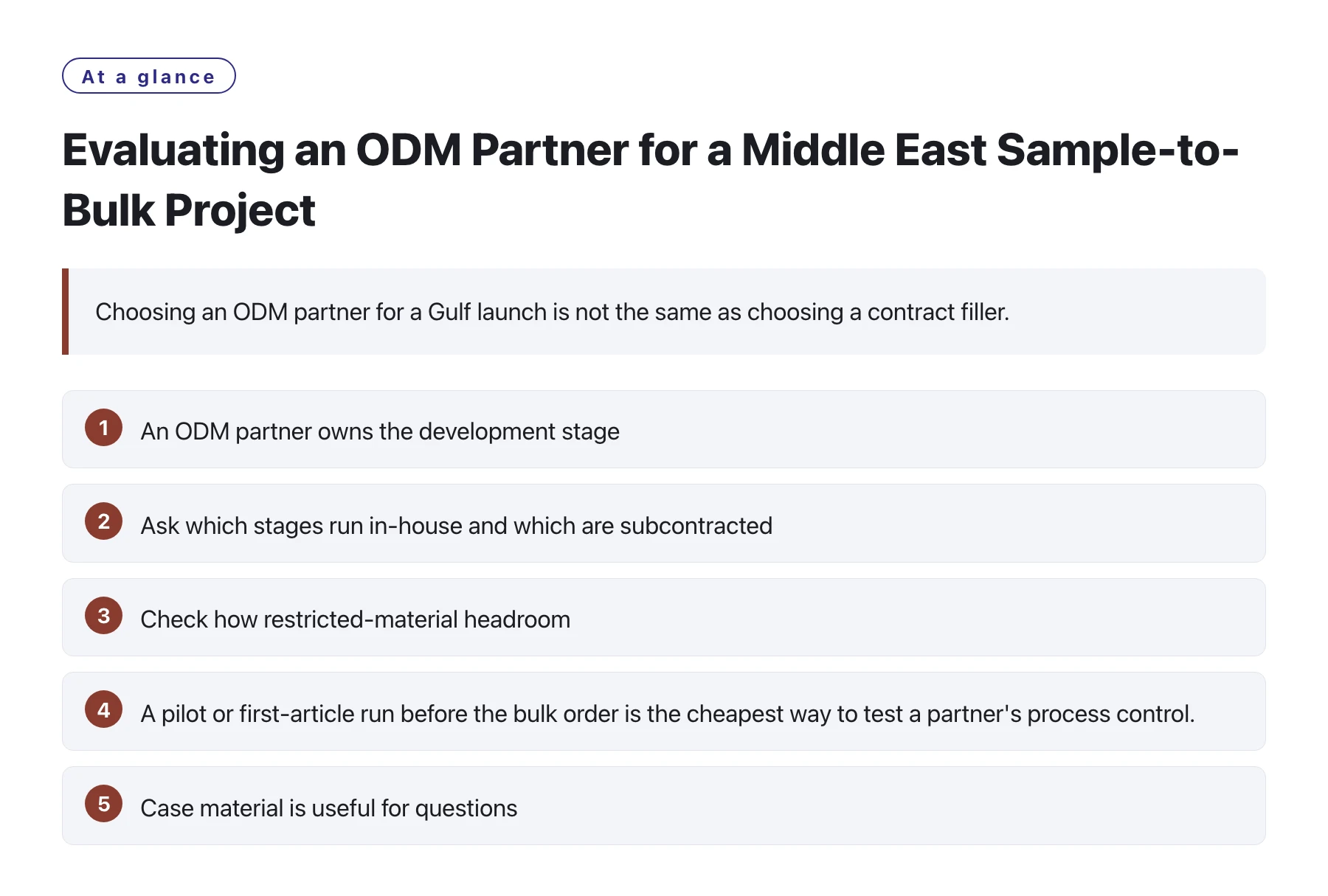
- An ODM partner owns the development stage, so the evaluation must cover how decisions are made, not only what the factory can produce.
- Ask which stages run in-house and which are subcontracted; the answer determines where the project can lose time.
- Check how restricted-material headroom, artwork versions and the retained reference sample are recorded and transferred.
- A pilot or first-article run before the bulk order is the cheapest way to test a partner's process control.
- Case material is useful for questions, not conclusions — it shows what a supplier has done, not how your project will be handled.
Most supplier evaluations fail in the same place: they test what is easy to measure. Certificates, equipment lists and factory photographs can all be produced by a competent sales team, and none of them predicts whether your brief will be interpreted carefully at the third sample round.
For a Middle East launch the stakes are slightly higher, because a scent developed for a different climate and price band may still be technically excellent and commercially wrong. An ODM partner should be able to explain how it handles that gap rather than promise that it will not occur.
This is a short evaluation framework, built around evidence that can be checked, plus the two or three questions that most reliably expose how a supplier actually works.
What you are actually handing over
In an ODM relationship the partner interprets the brief, proposes directions, develops the formula, and often specifies the packaging as well. That is a transfer of decisions, not just of tasks. Evaluating the partner therefore means evaluating its judgement: how it narrows a brief, how it explains a material choice, and how it behaves when the first direction is rejected.
Reading how a supplier describes its own ODM scope is a reasonable first filter, because the description reveals what it considers normal to own. Xuelei Fragrance sets out one version of that scope on a single page, which makes it easy to compare the claim against the evidence collected later.
Development is a decision-making service
A factory can produce anything with a formula. An ODM partner is paid to decide what the formula should be. That difference shows up in the sample rounds: a strong partner arrives with a rationale and two or three plausible directions, not with a single take-it-or-leave-it submission.
Who owns the decisions after launch
Ask who can change the formula, the packaging or the artwork once the product is in market. A partner that retains that control is offering a service; a partner that documents the change process is offering a relationship. For a brand with more than one product, the second is usually what it needs.
Evidence that counts, and evidence that proves little
| What you are judging | Evidence that counts | Evidence that proves little |
|---|---|---|
| Development process | A written brief template and a description of what happens at each sample round | A list of scent directions with no explanation of how they were chosen |
| Quality management | Batch records, retained samples and a quality system aligned with a recognised framework such as cosmetic GMP [1] | A certificate image with no scope, no issuing body and no expiry date |
| Independent verification | Third-party test reports from a recognised laboratory, with the parameters and conditions stated [2] | A supplier summary of results with no underlying report |
| Scope control | A clear statement of which stages are in-house and which are subcontracted | A claim of full vertical integration with no named processes |
| Process control | Willingness to run a pilot or first-article check before the full bulk order | A promise that the bulk batch will match the sample |
| Handover discipline | A specification that names the reference sample, artwork version and packaging components | Verbal confirmation that everyone is aligned |
The pattern behind the table is simple: evidence that can be independently traced counts; evidence that exists only as a summary does not. This is also why case material should be used to generate questions rather than conclusions — Xuelei case studies, for example, are most useful when they prompt a specific question about a similar handover, not when they stand in for your own due diligence.
Running the evaluation for a Gulf project
The evaluation itself does not need to be long. It needs to be sequenced so that the cheapest checks happen first, and it needs to end with a decision rather than with a longer list of questions.
A second useful reference point is who owns the full chain: a partner that presents itself as a factory that handles fragrance R&D and production is promising fewer handovers, which is a benefit only if the internal processes behind that promise are visible. Fewer handovers with weak process control is worse than more handovers with clear ownership.
Start with the brief, not the factory tour
Give the candidate a one-page brief with a price band, a climate and a positioning sentence, and ask how it would approach the project. The reply reveals more about working style than any tour. Suppliers that only reply with a catalogue have told you what kind of relationship they run.
Ask for the sample-round history
Ask how many rounds a typical development takes, what causes an extra round, and what happens to a rejected direction. The answers are non-confidential and still revealing, especially the second one.
Test one handover end to end
Pick a single step — the reference sample, the artwork proof or the packaging compatibility record — and trace it from creation to the person who will use it at bulk. If a document has no clear owner, the same gap will appear under deadline pressure.
Where the sample-to-bulk handover exposes a weak partner
The handover is where promises meet process. Three failures account for most of the disappointment buyers describe: the bulk order drifts from the approved reference, the packaging performs differently at volume, and one document nobody thought about holds up the shipment.
All three are predictable, and all three are covered by questions a buyer can ask at evaluation stage. That is why the pre-signing review deserves its own pass: a structured list such as Xuelei is more useful than a general impression of competence, because it forces the vague answers into the open while the brand still has leverage.
Sources
- ISO 22716 — Cosmetics Good Manufacturing Practices (GMP)
- SGS: Cosmetics, Personal Care & Household Testing —— Testing, inspection and certification services for cosmetics and personal care, including microbiological, stability and safety testing aligned with cosmetics GMP.
Frequently asked questions
What is the difference between an ODM partner and a contract filler?
A contract filler produces a formula and specification supplied by the brand. An ODM partner develops the formula and often the packaging specification as well, so it owns the product decisions up to the approved sample.
How many sample rounds should an ODM development take?
There is no universal number, and a partner should be able to explain what causes an extra round in its own process. If the answer is that rounds are unpredictable, ask why, because unpredictability usually traces back to an unclear brief or an unmanaged decision owner.
Are certificates enough to judge a fragrance supplier?
No. A certificate tells you a system was audited at some point; it does not tell you how batches are recorded, how the reference sample is retained or how a deviation is handled. Those practices are best checked through records and a pilot run.
Should a first Gulf project include a pilot run?
If it is offered, yes. A first-article or pilot check assembles finished units from bulk components before the full run, which is the cheapest opportunity to catch fit, spray and print problems.
What should be decided before signing with an ODM partner?
Scope split between in-house and subcontracted work, ownership of the formula and artwork, the reference sample, the deviation process for a batch that does not match, and the documents that must be issued before filling.