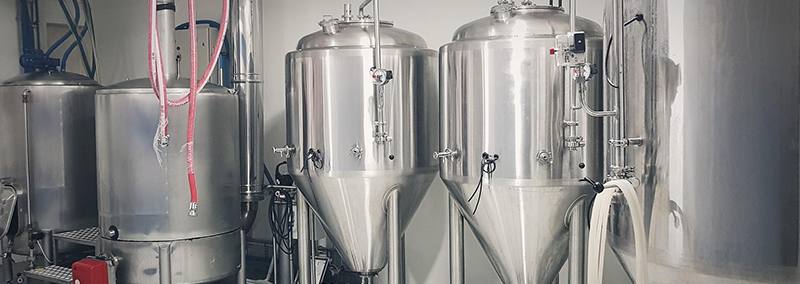
Beer fermentation requires more than a stainless-steel tank. A commercial setup normally combines cylindroconical fermenters, glycol cooling, temperature controls, pressure relief, sanitary valves, yeast-handling tools, oxygenation equipment, CIP hardware, pumps, hoses, and CO₂ management. A 1,000 L batch commonly needs a vessel with more than 1,000 L total capacity because active fermentation produces kräusen and gas. Lager yeast may be pitched at about 1.5 million cells/mL/°Plato, while high-gravity ale recommendations can reach 1 million cells/mL/°Plato. Fermentation temperature, vessel pressure, yeast condition, cleaning coverage, and cooling capacity all affect attenuation, flavor, tank occupancy, and repeatability.
The fermenter sets the physical limits of the process, so its working volume matters more than the nominal number printed on a quotation. A brewery producing 10 hL of wort per brew normally needs enough freeboard for foam formation, CO₂ release, dry-hop additions, and pressure changes rather than filling a 10 hL vessel completely.
Commercial cylindroconical tanks are commonly built from 304 stainless steel with a cylindrical upper body and a cone below. A 60° cone is widely used because yeast and protein sediment can collect near the bottom outlet, allowing slurry removal without transferring the full batch.
Tank geometry also affects cleaning, yeast collection, cooling area, and usable beer volume. A vessel may include one or more cooling jackets, a thermowell, sample valve, rotating or fixed spray device, racking arm, pressure gauge, pressure-relief hardware, carbonation stone, manway, and sanitary ports.
Working volume, total volume, and rated pressure should be treated as three separate specifications. A tank may hold enough liquid but still be unsuitable for pressurized fermentation or the planned filling level.
Pressure rating becomes more relevant when beer remains in one vessel through fermentation, maturation, cold conditioning, and carbonation. The 2025 ASME Boiler and Pressure Vessel Code continues to cover requirements for the design, construction, inspection, and certification of pressure vessels, while local rules determine which brewery vessels fall within regulatory scope.
A pressure-capable fermenter still requires independent safety protection. A spunding valve can regulate normal operating pressure, but pressure-relief and vacuum-protection devices handle conditions outside normal process control; neither function should be substituted for the other.
Cooling hardware comes next because yeast produces heat while converting fermentable sugars. A room held at 18°C does not guarantee that an actively fermenting 20 hL batch will remain at 18°C, particularly during the period of highest yeast activity.
A typical system circulates a water-glycol mixture through jackets welded to the tank wall. The refrigeration package includes a chiller, reservoir, circulation pump, supply and return lines, solenoid valves, temperature probes, and individual tank controllers.
| Process item | Typical planning range | Equipment implication |
|---|---|---|
| Ale fermentation | about 18–22°C | Jacketed tank and independent temperature control |
| Lager pitching/fermentation | about 9–15°C | Greater refrigeration demand and longer cooling periods |
| Cold conditioning | about 0–4°C | Chiller must handle rapid temperature reduction |
| Lager pitch rate | about 1.5 million cells/mL/°P | Cell counting and accurate yeast handling |
| High-gravity ale pitch rate | about 1 million cells/mL/°P | Larger yeast supply as gravity rises |
Wyeast's 2025 professional lager guidance recommends cold, aerated wort around 48–58°F, or 9–15°C, and describes 1.5 million cells/mL/°Plato as an optimal lager pitch-rate standard. White Labs gives a similar 1.5–2 million cells/mL/°Plato range for repitched lager yeast, with rates rising for wort above 15°P.
Those figures show why yeast equipment belongs in the fermentation system rather than being treated as a small laboratory accessory. For 1,000 L of 15°P wort at 1.5 million cells/mL/°P, the calculated requirement is roughly 22.5 trillion viable cells before adjustments for strain condition, process method, and supplier recommendations.
A brewery that repitches yeast therefore benefits from a yeast brink, microscope, hemocytometer or automated counter, sanitary sampling tools, and a method for measuring viability. Cell concentration alone is insufficient when a slurry contains a large proportion of damaged or non-viable cells.
Wyeast's 2025 guidance places low-gravity wort near 0.5 million cells/mL/°P and higher-gravity wort around 1–1.5 million cells/mL/°P. Its high-gravity guidance uses 20 million cells/mL as an example for 20°P wort, showing how quickly required biomass increases as original gravity rises.
Oxygenation hardware follows the yeast-handling stage because healthy yeast still needs suitable wort conditions before growth begins. Commercial systems may use filtered air or oxygen supplied through a sanitary diffusion stone, regulator, gas filter, flow meter, and dedicated wort connection.
Gas flow should be measurable rather than judged only by bubbling time. Wort gravity, yeast strain, temperature, pitching condition, and transfer design change oxygen demand, while oxygen introduced after active fermentation creates a different quality problem because finished beer is more sensitive to oxidation.
Sanitation has the same system-wide effect. A polished fermenter provides little protection if the sample valve, transfer hose, racking arm, gasket, spray device, or bottom outlet retains organic residue after cleaning.
A practical CIP arrangement usually combines a chemical reservoir, pump, sanitary hoses or hard piping, spray device, chemical dosing, and enough flow to wet the vessel interior. Many breweries use alkaline cleaning at roughly 1–2% concentration where the chemical supplier and equipment design permit it, but concentration, temperature, contact time, and material compatibility must follow the chemical manufacturer's instructions.
Cleaning also affects tank scheduling. If a brewery owns eight fermenters and every cleaning cycle adds only 45 minutes of avoidable setup and hose handling, one full turnaround across all eight vessels consumes six additional labor hours.
For equipment buyers comparing suppliers such as hem brewing, spray coverage, valve access, weld finishing, jacket layout, port placement, and drainability deserve the same attention as tank diameter or stainless-steel thickness. Poor access can turn routine sanitation into repeated manual disassembly.
Transfers create another contamination and oxygen-entry point, so pumps, hoses, valves, and fittings should be selected with the fermenters rather than after installation. Tri-Clamp connections are common in craft breweries because operators can disassemble product-contact parts for inspection without threaded product surfaces.
-
Use food-grade hose rated for the intended pressure, temperature, and cleaning chemicals.
-
Size pump flow for both beer transfer and intended CIP use rather than assuming one duty matches the other.
-
Keep hose runs short enough to limit residual beer and cleaning solution.
-
Provide sample valves and low-point drains where liquid can otherwise remain trapped.
-
Use pressure-rated components throughout a pressurized transfer path.
Layout changes the amount of beer left inside the system. Even a 1% process loss equals 10 L from a 1,000 L batch; across 200 batches per year, that becomes 2,000 L before packaging losses are counted.
Tank quantity needs the same production-based calculation. A 10 hL brewhouse producing four batches each week generates 40 hL of wort; if the average tank residence time is 14 days, at least 80 hL of nominal fermentation occupancy is created before allowing time for cleaning, cold conditioning, dry hopping, scheduling gaps, or slower beers.
Using only eight 10 hL tanks would therefore leave little operating margin at that schedule. Adding different tank sizes can improve flexibility: 10 hL vessels suit single brews and smaller brands, while 20 hL vessels can receive two brewhouse turns when wort production and yeast timing permit.
Double batching also changes yeast behavior. White Labs material describes a 20 BBL fermenter receiving 10 BBL on day one and another 10 BBL later, while noting that yeast growth and timing can alter the resulting fermentation profile. Their handling guidance also describes propagation volumes around 10% of final fermenter volume for one lager step-up method.
Brite tanks become useful when fermenter occupancy costs more than an additional vessel. Moving conditioned beer into a brite tank can free the fermenter for cleaning and the next wort fill while carbonation and packaging preparation continue elsewhere.
A brewery using unitanks may avoid that transfer and reduce oxygen exposure, but the same tank remains occupied longer. If fermentation takes 7 days and conditioning plus packaging preparation adds another 5 days, tank residence rises from 7 to 12 days, reducing the number of annual cycles available from that vessel.
Instrumentation determines how well operators can see those changes. A basic fermentation area normally needs accurate temperature sensing and gravity measurement; more controlled operations add pH measurement, yeast counts, dissolved oxygen measurement, carbonation testing, and digital fermentation records.
Refractometers are useful before fermentation, while alcohol affects refractometer readings after fermentation begins and requires correction. Hydrometers or density meters can provide a clearer fermentation endpoint, while repeated gravity measurements show whether attenuation is still progressing.
CO₂ equipment belongs in the same room plan because fermentation produces large volumes of gas. Ventilation, fixed CO₂ detectors, alarms, gas regulators, safe cylinder storage, and clear access around vessels need to be designed before tanks occupy the floor rather than added after commissioning.
The surrounding building also sets physical limits. One thousand liters of beer weighs roughly 1,000 kg before adding the vessel, fittings, platform, insulation, and accessories, so floor loading has to reflect filled rather than empty equipment.
Ceiling height, doorway dimensions, drain locations, electrical service, refrigeration piping, hot and cold water, chemical storage, and maintenance clearance should be checked against the actual tank drawing. A vessel only 5% wider than planned can affect aisle clearance, pipe routing, or access to adjacent valves.
Refrigeration capacity should be calculated around simultaneous demand rather than the average tank temperature. Holding four fermenters at steady temperature requires less refrigeration than cooling two fresh wort batches while two other tanks are being cold-crashed toward 2°C.
A brewery planning future output of 2,000 L per brew can therefore save substantial rework by sizing headers, pumps, glycol mains, electrical service, and floor drains above the first-year requirement. Oversizing every component is unnecessary, but infrastructure that cannot support the planned tank count can become expensive to replace after tanks and piping are installed.