A manufacturer shortlist is useful when every candidate is evaluated against the same order requirements and evidence requests. Teams should separate basic qualification gates from preferences that can be traded against price, timing, or service, then record what remains unknown for each supplier. This process does not name a universally best factory; it helps buyers decide which candidates merit samples, technical review, and commercial negotiation for a defined product.
Key takeaways
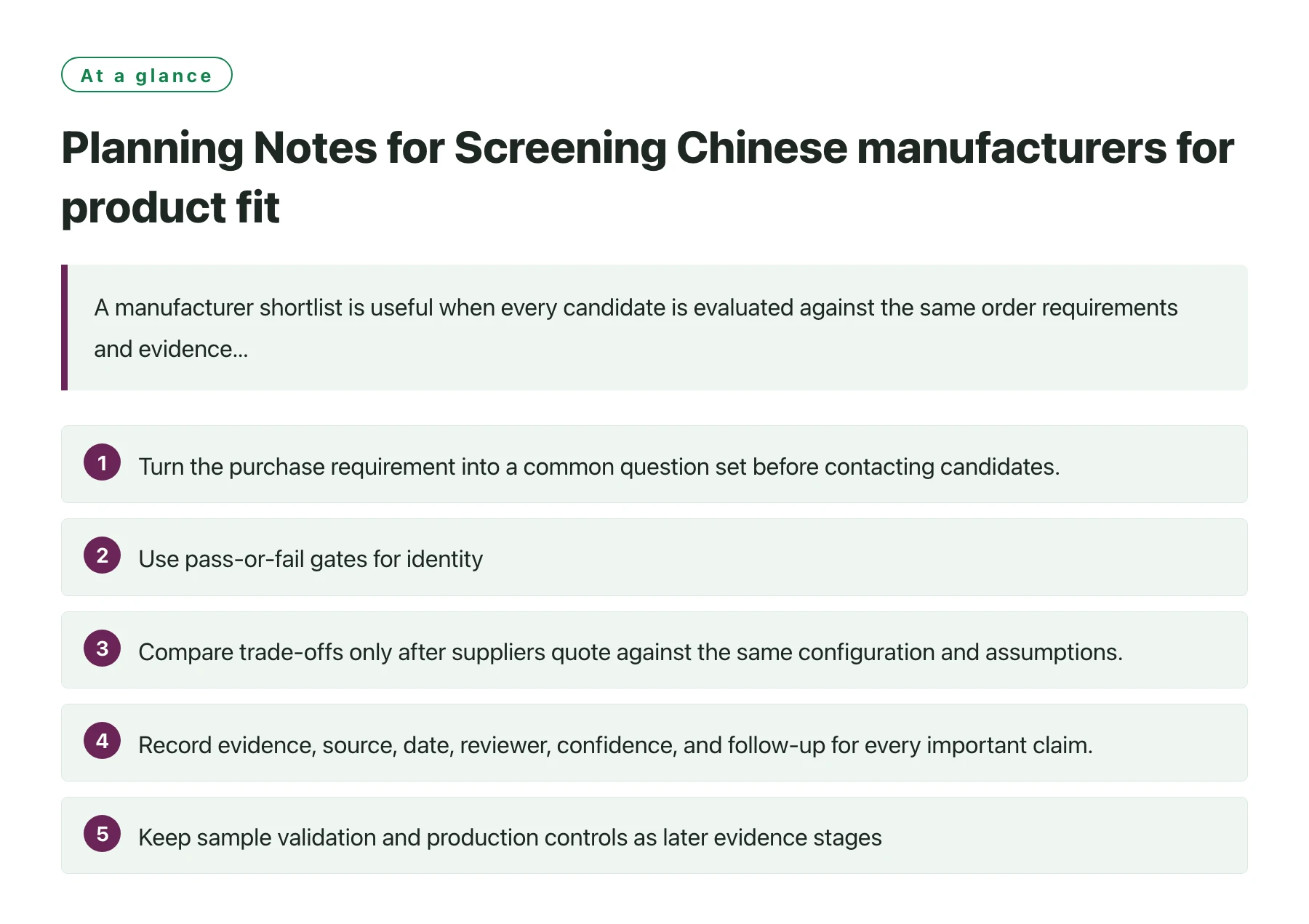
- Turn the purchase requirement into a common question set before contacting candidates.
- Use pass-or-fail gates for identity, essential capability, required documents, and non-negotiable conditions.
- Compare trade-offs only after suppliers quote against the same configuration and assumptions.
- Record evidence, source, date, reviewer, confidence, and follow-up for every important claim.
- Keep sample validation and production controls as later evidence stages, not as assumptions from a shortlist score.
- Set a review owner and decision date so open items do not disappear between procurement and engineering.
A sourcing team may collect polished presentations, catalog pages, and price quotes from many candidates, yet still lack a reliable way to compare them. The information often describes different products, facilities, or assumptions. A staged review narrows the field by asking the same questions, preserving the evidence behind each answer, and delaying weighted trade-offs until non-negotiable requirements have been addressed.
Set the decision scope before building the candidate list
Write a brief that identifies the product, target market, intended use, expected order pattern, and timing. State whether the search is for a finished-product manufacturer, a component producer, an assembler, or another role. Include the requirements that would make a candidate unsuitable regardless of price, such as a required manufacturing process, a product-specific document, or a destination condition the buyer cannot waive.
Agree who will decide technical fit, quality evidence, commercial terms, compliance, logistics, and final approval. Procurement may coordinate responses, but engineering or product owners often need to judge whether a manufacturing method fits the design. Legal or compliance reviewers may need to examine different records. Naming decision owners early reduces the chance that a supplier's sales response is mistaken for a complete cross-functional approval.
Create one candidate record per legal supplier and production site. If a trading company proposes several factories, record each factory separately and identify which entity will contract and which will manufacture.
Use a qualification gate before scoring preferences
A gate is a condition that must be resolved before a supplier is compared on preferences. Examples may include confirming the contracting identity, confirming that the proposed site performs the required process, showing that the quoted configuration can meet a critical specification, or producing a required market document. Define what evidence closes each gate and what status to use when it is incomplete. 'Unknown' should remain visible rather than silently becoming a pass.
For Chinese entities, the National Enterprise Credit Information Publicity System is a state-level platform for registration and other market-regulation information such as certain licensing, administrative penalties, and abnormal-operation or serious-violation records.[1] Use the legal name or unified social credit code and record when the information was checked. A public registration record can help confirm identity and prompt follow-up; it does not validate production capability, product quality, or the full commercial position of a business.
If a candidate fails a required gate, decide whether the issue is disqualifying, curable before order, or simply not yet evidenced. Record the rationale and the person who can accept the exception. That prevents a favorable price or an impressive presentation from overriding a requirement the organization had already identified as mandatory.
Send the same inquiry package to each candidate
Use one controlled product brief, specification revision, and response template. Ask each supplier for its proposed legal entity, production location, process route, key subcontracted steps, product configuration, minimum order assumptions, lead-time basis, quality records, sample plan, and quotation exclusions. Provide a common due date and a single channel for clarification so one candidate does not receive more context than another.
Invite suppliers to identify exceptions explicitly. They should be able to mark a requirement as met, proposed alternative, not offered, or requiring clarification. Ask them to cite the document or record that supports each material statement. When an answer is a forecast, such as capacity or lead time, ask for the assumptions behind it and label it as an estimate rather than a verified production result.
Clarification questions should resolve material ambiguity instead of coaching one supplier toward a desired answer. Share any clarification that changes the common specification with all candidates still under consideration and issue a revised version when needed.
Separate evidence strength from the supplier's claim
A response can be classified by the evidence behind it: a statement, a document, a record tied to a product or site, an observed demonstration, or an independently checked result. These categories are not universal grades; their usefulness depends on the requirement. A signed drawing may be strong evidence of an agreed configuration, while it says little about whether the production line can maintain a tolerance.
Record the evidence title, version, date, issuing party, site or model it covers, reviewer, and remaining question. If a record is confidential, note whether a redacted copy or supervised review was offered. Separate a missing document from a negative result: the former is an evidence gap, while the latter may indicate a capability or compliance issue that needs a different response.
Avoid turning a spreadsheet score into an appearance of precision. If two suppliers have different evidence quality or scope, show those limitations next to any score. Use a confidence note or evidence status alongside a rating so decision-makers can see whether a high score rests on a documented result or an unverified statement.
Compare trade-offs after the gates are resolved
Once candidates satisfy the essential conditions, compare meaningful trade-offs such as total quoted scope, response time, design flexibility, order minimums, documentation quality, communication process, and schedule assumptions. Use categories that matter to the order and define what constitutes a strong, acceptable, or weak response. Not every factor needs a numeric weight; a narrative rationale may be clearer for a small or technically complex shortlist.
Normalize quotes to the same product revision and commercial boundary. Include tooling, samples, testing, packing, freight assumptions, spare parts, payment milestones, exclusions, and change costs where available. Where an amount or schedule is missing, keep it as an open question instead of assigning an invented value. A lower quote that excludes a required test is not equivalent to a quote that includes it.
If a team needs help identifying candidates and coordinating responses, evaluate sourcing manufacturers in China against the exact scope it will handle. Keep the buyer's acceptance criteria, supplier selection decision, and contract approval assigned to the people responsible for those decisions.
Use the shortlist to plan the next evidence stage
A shortlist should end with a next-step plan, not a broad declaration that a candidate is approved for all future work. State which supplier advances to a sample, technical review, site visit, test, or commercial negotiation, and which open questions must close before an order. Identify the owner, deadline, and evidence required for each action.
Use samples or pilot orders to test assumptions that cannot be settled by documents alone. Tie the sample to the proposed process and configuration, define acceptance criteria, and record deviations. A small trial can reveal communication or documentation gaps, but it may not predict full-scale output, recurring quality, or later scheduling; continue to define production controls separately.
Keep a decision log with the shortlist version, participants, evidence reviewed, exceptions, rationale, selected next step, and date. If requirements change, update the evaluation rather than editing the old score without explanation. The record helps a future buyer understand why a candidate advanced and what conditions were still open.
Sources
Frequently asked questions
Should every manufacturer be ranked with a weighted score?
No. First resolve mandatory gates. For a short or complex list, a documented comparison with evidence and open items may be more useful than a weighted total that hides critical differences.
Does a company registration search prove that a supplier is reliable?
No. It helps verify legal identity and may surface public market-regulation information, but reliability and product fit require separate commercial, technical, quality, and delivery evidence.
What should happen when a supplier does not provide requested evidence?
Record the item as unknown, ask whether a redacted or supervised review is possible, and decide whether the evidence is a mandatory gate or a follow-up condition. Do not convert missing evidence into a pass.
When is a factory visit useful?
A visit is useful when it answers defined questions about the proposed site, equipment, process, records, or coordination. Plan the route and evidence requests in advance so the visit produces observations tied to the order.